Countries

Spain Finland Hungary Italy Lithuania Spain Finland Hungary Italy Lithuania Spain Finland Hungary Italy Lithuania

Tuesday, May 6, 2014

The Moses

The Moses  is a sculpture by the Italian High Renaissance artist Michelangelo Buonarroti, housed in the church of San Pietro in Vincoli in Rome. Commissioned in 1505 by Pope Julius II for his tomb, it depicts the Biblical figure Moses with horns on his head.

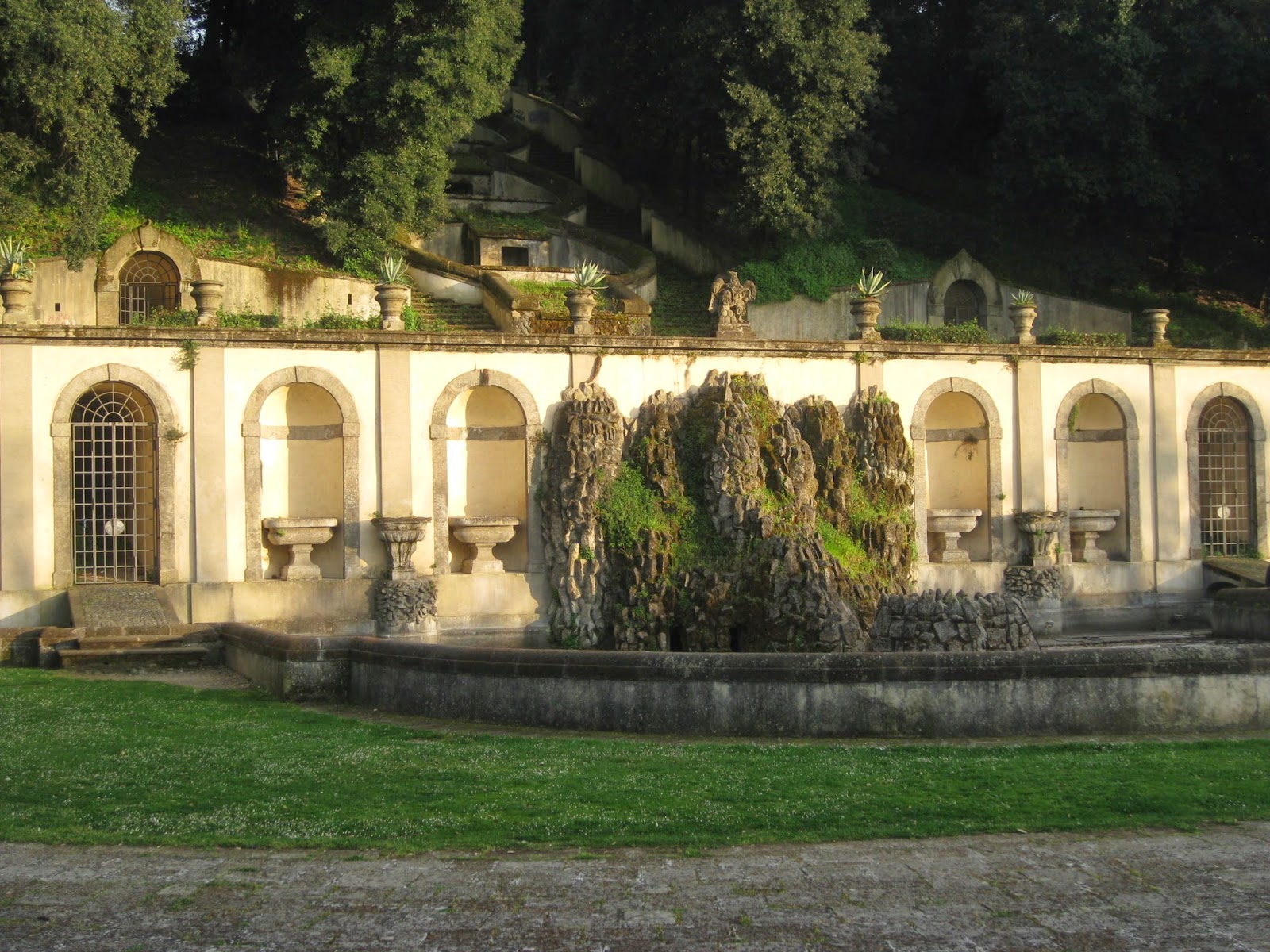
Parco di Villa Torlonia

A public park in Frascati, which was built between 1721-1724. It is one of the most beautiful of the Ville Tuscolane, an extension of the natural beauty of Tusculum. The garden is set on two levels: a terraced garden and an upper part, which follows the natural slope of the land with a forest of oaks, where a pond spoils into a cascade.

The Altare della Patria

  1. The Altare della Patria (Altar of the Fatherland) also known as the Monumento Nazionale a Vittorio Emanuele II (National Monument to Victor Emmanuel II) or "Il Vittoriano"  located in Rome, Italy. It occupies a site between the Piazza Venezia and the Capitoline Hill.
  2. The Altare della Patria  is a controversial monument built in honour of Victor Emmanuel, the first king of a unified Italy.
  3. The eclectic structure was designed by Giuseppe Sacconi in 1885; sculpture for it was parceled out to established sculptors all over Italy, such as Leonardo Bistolfi and Angelo Zanelli. It was inaugurated in 1911 and completed in 1925.
  4. To date, the Vittoriano is the largest monument in white marble Botticino (Brescia) ever created, and features stairways, Corinthian columns, fountains, an equestrian sculpture of Victor Emmanuel and two statues of the goddess Victoria riding on quadrigas.
  5. The base of the structure houses the museum of Italian Unification. In 2007, a panoramic elevator was added to the structure, allowing visitors to ride up to the roof for 360 degree views of Rome. 
  6. The monument was controversial since its construction destroyed a large area of the Capitoline Hill with a Medieval neighbourhood for its sake. The monument itself is often regarded as pompous and too large. 
  7. Maybe it is really too large, but I liked it. Although in Roma there are a lot of incredible places, it is one of the most beautiful place in Roma.


Altare della Patria


1. The Altare della Patria (Altar of the Fatherland) in Rome, Italy.
2. A controversial monument built in honour of Victor Emmanuel, the first king of a unified Italy.
3. It was designed by Giuseppe Sacconi in 1885, inaugurated in 1911 and completed in 1925.
4. It features stairways, Corinthian columns, fountains, an equestrian sculpture of Victor Emmanuel made out of marble and two statues of the goddess Victoria riding on quadrigas.
5. Though not held in the highest esteem by present-day citizens, it was the source of great civic pride at the time of its construction, at the turn of the 20th century.
6. I find it really impressive and beautiful.

-Kamilė Skorupskaitė

Monday, May 5, 2014

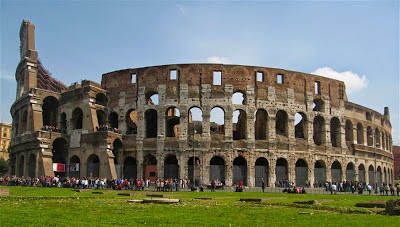
Colosseum


1.  The Colosseum or Coliseum (also known as the Flavian Amphitheater), in the center of the city of Rome, Italy.
2. An elliptical amphitheater.
3. Construction began under the emperor Vespasian in 70 AD and was completed in 80 AD under his successor and heir Titus.
4. An ancient building built of concrete and stone, it was the largest amphitheater of the Roman Empire, and is considered one of the greatest works of Roman architecture and engineering.
5. The Colosseum could hold, it is estimated, between 50,000 and 80,000 spectators, and was used for gladiatorial contests and public spectacles such as mock sea battles, animal hunts, executions, re-enactments of famous battles, and dramas based on Classical mythology. The building ceased to be used for entertainment in the early medieval era. It was later reused for such purposes as housing, workshops and quarters for a religious order, a fortress, a quarry, and a Christian shrine.
The Colosseum is an iconic symbol of Imperial Rome. It is one of Rome's most popular tourist attractions and has close connections with the Roman Catholic Church, as each Good Friday the Pope leads a torch lit  "Way of the Cross" procession  that starts in the area around the Colosseum.
6. It is the largest amphitheater in the world. Nothing like it is anywhere else in the world.
7. The Colosseum in Rome arouses more emotion than any other structure from this ancient culture. I was moved to tears at all that this structure stood for. It is truly colossal.

Sunday, May 4, 2014

Ara Pacis

Detail of a scene of the gods 
1.Museo dell’Ara Pacis in Roma
2.Roman temple with altar in honour of Augustus’ return from Galia & Hispania
3.The Roman Senate voted for its construction in 13 B.C. on Campus Martius
4.It is an almost square monument of marble of 10 mts. side and 6 mts. high depicting ornamental plants in lower part and roman personalities tied to Augustus on higher part and some mythological high reliefs
5.Ara Pacis is located close to Tiber river in a museum and it is visited frequently by groups of students
6.This kind of Roman temple is very singular and original, very different than other interesting Roman constructions like triumphal arches and columns.
7. Ara Pacis is isolated from the busy transit in the outside. It can be visited slowly and see all details, decorations and characters who appear there. Its visit transport us back 2000 years to the glorious Roma past.

Jordi Ribas

Friday, May 2, 2014

Saint Nilo Abbey Grottaferrata


1-     Grottaferratta Abbey
2-    Abbey of Saint Nilo, church of Santa Maria, library and walls.
3-    Started in XI century, it was enriched with frescoes in XIII and XVII century
4-    It combines art from different styles from Romanesque to neoclassical
5-    The location of the Abbey dominates a nice landscape scenery.  
6-    The abbey buildings are rather familiar. The type of church and its tower are not very different of those in Spain
I liked the different places of the abbey we visited: the entry with the walls, the cloister, the church and the surrounding landscape and mainly the frescoes inside the church and the celebration there which remind me of the orthodox way
Jordi Ribas